

Why Practice Deep Listening?
I first became familiar with Pauline Oliveros’ work when I made a complete 360 in my then office career and returned to university to study Music and Sound. While researching the role of women in the development of electronic music and music technology, I discovered Oliveros’ experiments with tape machines and her sound practice known as Deep Listening.
It began as Oliveros’ personal listening practice in the late 1960s, developed in response to the political and social climate of America at the time and therefore was aimed at reconnecting with oneself amidst the ongoing violence of the Vietnam war. Oliveros described listening as an active act, compared to hearing which is passive. The ultimate goal of her practice was learning to “listen to everything all the time” and remind herself when she wasn’t listening. The result of many years of practicing alone and in private groups was Sonic Meditations, a collection of listening exercises designed to heighten awareness of both the world and the social structures within it.

The concept of Deep Listening resonated deeply with me, whether I was composing a piece of music or simply taking five minutes to bring awareness to the sounds I was unconsciously blocking out. I was surprised by just how much of the sonic world around me I tune out every day, probably understandable when you are surrounded by London’s constant hum. While Oliveros’ Sonic Meditations offer an extensive list of exercises, I found I needed to adapt the practice to my own routine. I began by practicing at home while working remotely, taking short breaks to tune into sounds around me: neighbours talking downstairs, a washing machine upstairs, a train passing a few streets away, the hum of a lamp, birds outside. I try to hear all the sounds at once like a symphony of noises, then focus on each in turn. This simple habit has made me more aware of my surroundings and more responsive to sounds I once ignored. Sometimes, I add on to these whether it is using my voice or body like in Sonic Meditations. One day I hope to do these exercises in the group.
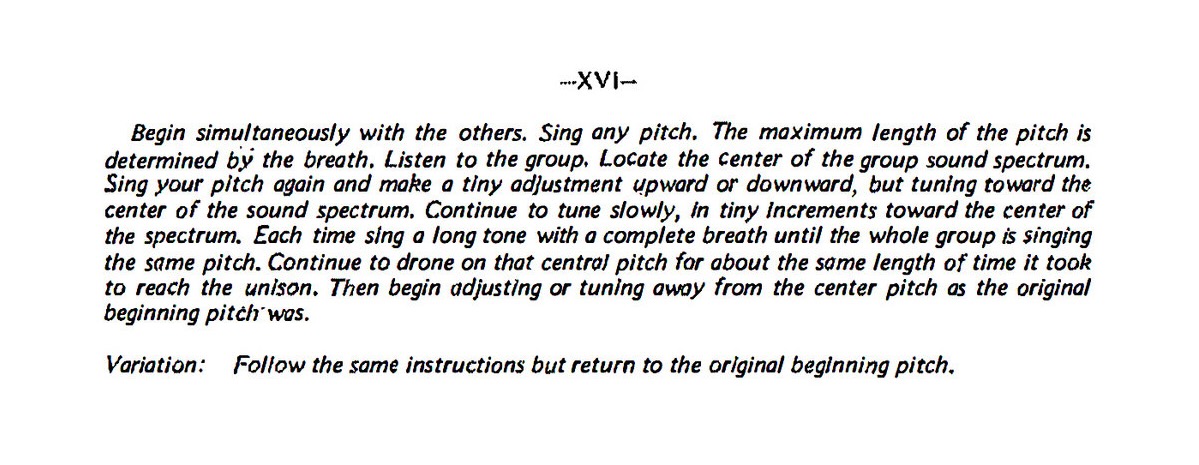
Today, as AI agents become increasingly integrated into our creative processes, listening feels like a radical creative act, one that helps preserve and nurture human creativity for both creators and audiences. The way humans experience sound is profoundly unique and, in my opinion, can never be replaced by machines. As Oliveros suggested, listening extends beyond sonic vibrations (which are themselves uniquely human experiences) to encompass memory and emotion. Pair Deep Listening with the research that goes into every decision of a sound professional, and you get authentic sound, sound that connects with an audience on a subconscious level. Whether it’s a soundscape created to reflect reality of the past events as closely as possible, as in Warfare (2025), or the research and experimentation exploring how a deaf person experiences sound in Code of Silence, these works are elevated by the curiosity of the listener and their willingness to engage deeply with the sonic world.
For me, taking at least five minutes each day to practice listening keeps that curiosity alive. It helps me understand the world around me, how it changes, how it impacts me while at the same time helps me connect deeper with others around me. And for those who want to explore further, there’s so much to discover in Pauline Oliveros’ Sonic Meditations and her writings on Deep Listening.


